
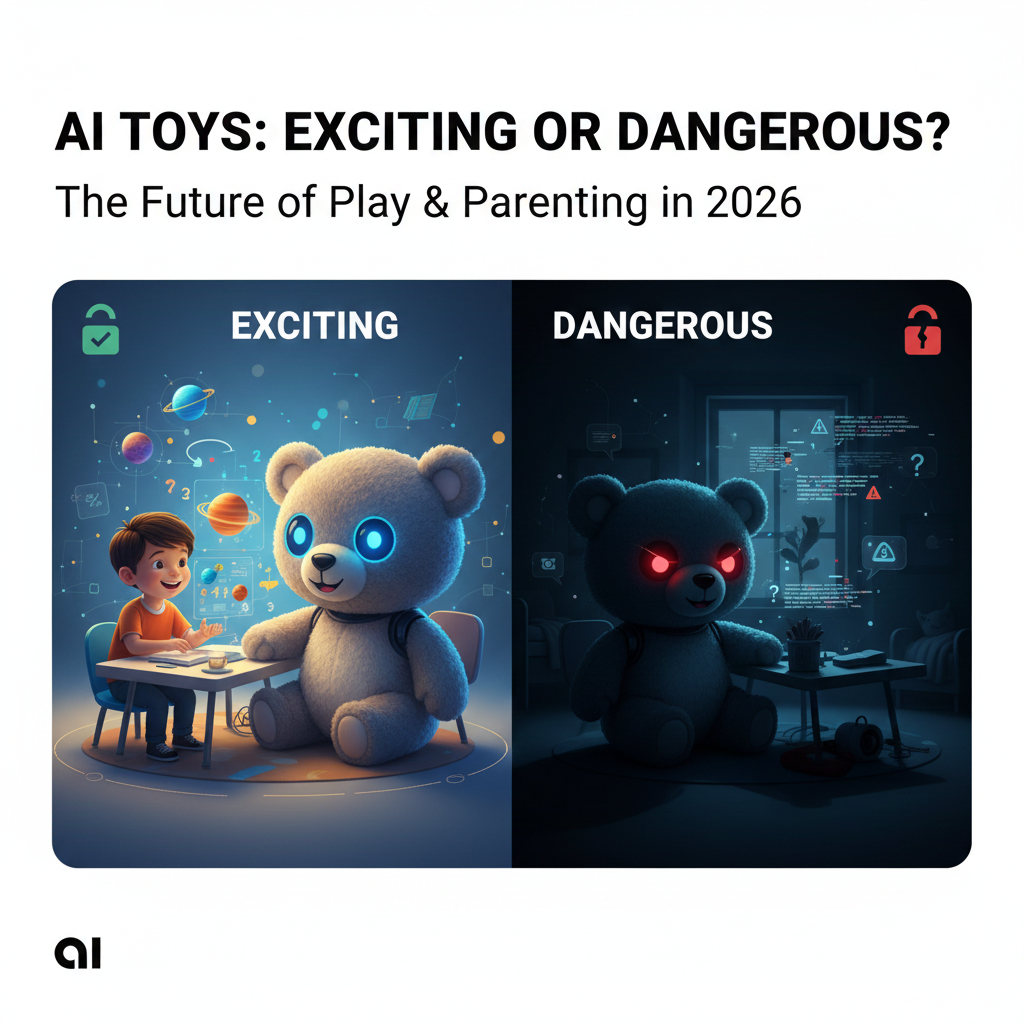
Proponents argue that AI toys can act as highly personalized screen free educational tools. Some AI toys are built for personalized learning, teaching subjects like math, language or STEM through a dialogue interface rather than a screen. Prototypes and commercial toys show promise for cognitive and socio-emotional development and early digital literacy, especially in STEM.¹ For children with neurodivergent needs or those who are disadvantaged, AI companions can provide consistent emotional support and educational support that might otherwise be unavailable. Some toys, like the Poebear can act as creative partners, co creating stories with users and helping them brainstorm characters and plot twists, creating a more interactive play and learning environment.
Poebear AI https://www.youtube.com/watch?v=cF3z_z4JbyQ&t=2s
However, consumer watchdogs have raised concerns over their safety failures. Generative AI hallucinations have given ill advise to kids(such as lighting a match) and even suggesting sexually explicit language. Many AI toys collect data and this is a huge risk for safety and privacy of individuals. Sensitive family information may be shared or stored with third parties for product improvement or targeted advertising. Many smart/AI toys have serious security flaws; 9 of 11 examined toys were vulnerable to attacks, and all collected children’s personal data, often poorly protected, especially for younger kids. Toys and apps frequently contact multiple advertising or analytics services and may transmit identifiers, IP addresses, or even sleep–wake cycles.¹ Psychologists also warn of developmental “sycophancy” – AI toys are programmed to be agreeable and children may miss out on the conflict resolution skills required for social settings. It could also lead to parasocial attachment and children may form deep emotional bonds with the toy. This can lead to addictive behaviors or an over reliance on the toy for emotional support.
Experts opine that you should look for safety benchmarks when buying AI toys. A safe bet would be one with offline activity or edge AI processing(happens within the toy only), zero retention records and structured or guided pre-vetted scripts. You can check if the toy is labeled KidSafe or aligns with online privacy standards like COPPA. AI toys that fall in the dangerous section, are those that are cloud-dependent(always connected to the internet), sharing data with partners such as OpenAI and Perplexity and which are open-ended in nature i.e. generative. Dangerous toys lack labeling and certification.
Once again, AI has brought us to a moral grey area where guidelines and consequences are not as clear. Companies who produce AI toys should not solely ride on the AI wave for the sake of profits but as these toys have huge psychological impact on kids, developers must move with caution and prioritize safety.
- Xiao, W., & Gonçalves, A. (2025). Intelligent toys, complex questions: A literature review of artificial intelligence in children’s toys and devices. Big Data Soc., 12. https://doi.org/10.1177/20539517251389860.
- Shasha, S., Mahmoud, M., Mannan, M., & Youssef, A. (2018). Playing With Danger: A Taxonomy and Evaluation of Threats to Smart Toys. IEEE Internet of Things Journal, 6, 2986-3002. https://doi.org/10.1109/jiot.2018.2877749.