

Google personalization has evolved from just simple search history tracking to an integrated AI first system. It connects across your various google apps to provide you with precise personalized responses that are tailored to your desires. It is a digital assistant that understands your life and not just your keywords.
Google’s Personalization is fully integrated into Gemini 3, it connects apps such as Gmail, Google Docs, Photos and Drive. It is able to perceive information about your travel history, purchase history and your visual preferences(eg. design style of an outfit).
It provides personalized help based on your personal context. You can get highly relevant suggestions for vacation spots, project ideas and more. You can even share your preferences with Gemini, asking it to remember your interests, goals in life and writing style.
Gemini is able to consider your past chats, allowing you to easily pick up where you left off or have it summarize a previous topic for you or even synthesize past research with new ideas.
Because this level of personalization is so deep, Google has implemented stricter controls. Features like Gmail and Photos are opt in only. Google states that it uses your emails and photos to answer your queries but it does not use them to train its general AI models. When a result is personalized using your private data, a banner clearly states which source (e.g., “From your Gmail”) was used.
I decided to give it a go and the results are spookishly amazing.
I asked Google Personalization to tell me more about a document that I wrote, and it effectively provided an accurate summary of the text.

I next prompted Gemini to provide me new ideas based on tech and science articles it found in my apps, and it did a pretty good job.

I also wanted to see if Gemini was able to handle any of my workflows, so I asked it for a marketing strategy based on the documents in my apps. The results are pretty amazing, it suggested a detailed marketing plan for me and was even able to provide me with divergent ideas.

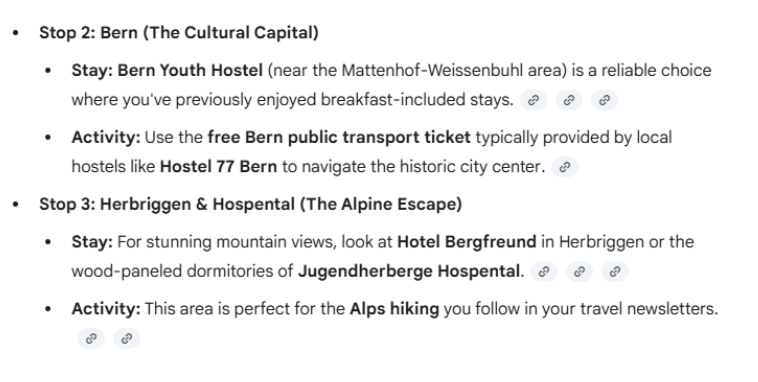
I was quite taken aback by my next experiment. So I asked Gemini to suggest a travel itinerary for me based on my emails. In seconds, it analyzed the thousands of emails that I had in my inbox and was able to dig up information about where I had previously booked a hotel, where I had breakfast, the booking apps that I used and even the airlines that I flew on. This is spookishly amazing. Is Google becoming CIA?
It brings into question the issue of information asymmetry. Do AI companies know too much about us? Developers have access to multi-dimensional datasets such as location, biometrics and purchasing behavior. This creates the black box problem where customers can see the data collected but they have no clue on how the algorithm functions. Data collected can be used for behavioural profiling and ad targeting. Giving AI free reign access to data that we may not have consented to takes away our privacy. It can even be used maliciously if sensitive information(like medical records) is leaked.
Leave your thoughts in the comments below about what you think about AI and privacy.