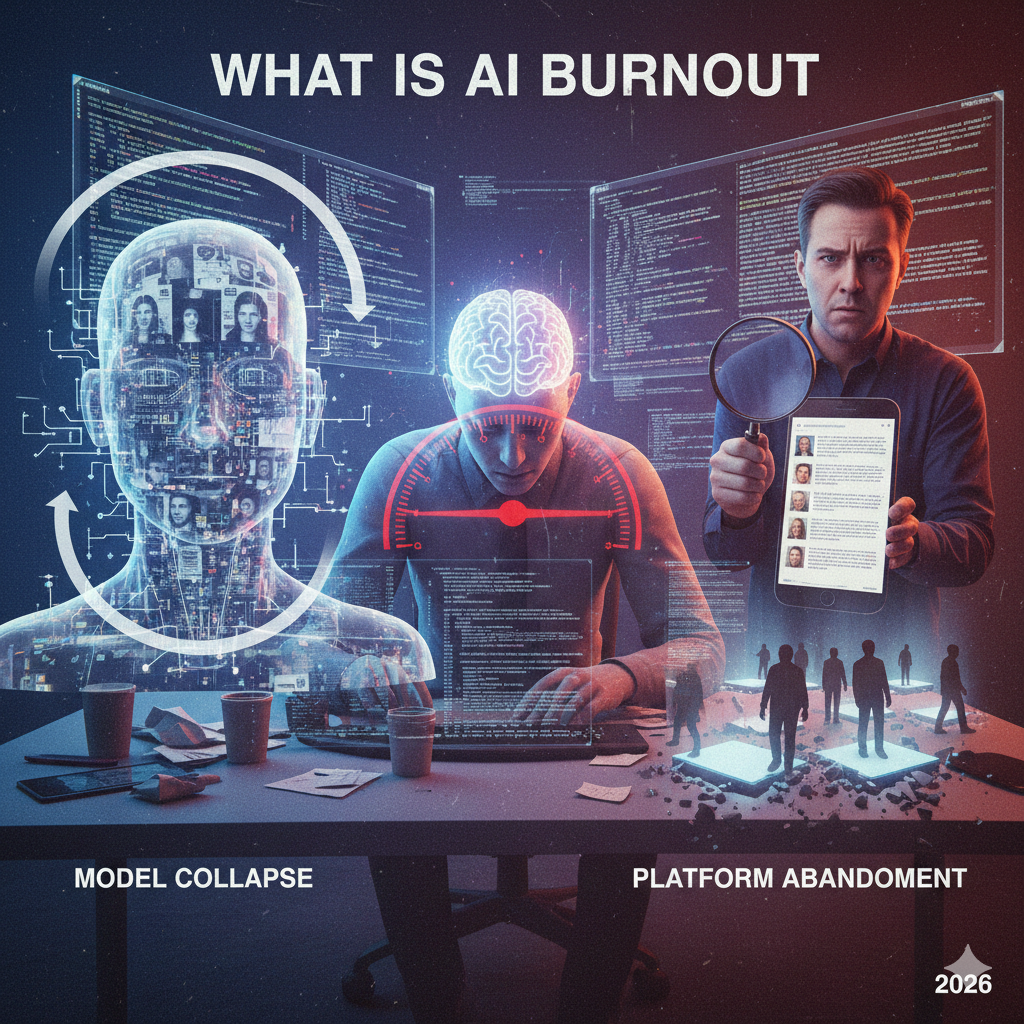
AI burnout refers to the exhaustion of the humans building and using AI and the technical degradation of the models themselves.
In the tech sector, AI burnout refers to the physical and mental exhaustion of researchers and engineers. The Velocity issue – the pace of “State of the Art” cycles have reduced from years to weeks, meaning that developers have to constantly update themselves with new AI tools so their current tech stack doesn’t become obsolete. The Human in the loop fatigue – Thousands of data labelers and reinforcement learning workers experience moral injury or cognitive load from reviewing endless streams of AI content, often containing toxic or disturbing content. Higher “AI awareness” in hotel and healthcare workers correlated with more burnout and turnover intentions, largely due to fears of replacement and psychological contract breach.¹ Misuse of generative AI in programming courses contributed to “learning burnout” via overload and overdependence² software developers and QA engineers reported extra validation work, reduced collaboration, and ethical stress leading to burnout risk.³
In computer science, AI burnout can also be used to imply model collapse. Situations that occur where AI models are trained on data generated by other AI models rather than human origin. As AI generated content becomes more pervasive on the internet, future models are most likely to ingest this synthetic data. As such the AI loses its competitiveness and begins to produce repetitive, bland or factually nonsensical output. It ultimately will forget how humans even write or speak.
AI burnout can also be used to categorize user burnout. For instance, users may feel an increased need to conduct fact checking on content produced by AI. Users may also feel mentally exhausted from keeping up with the deluge of AI products that enter the market. The “Dead internet” theory also suggests that since most online activity involves bot to bot interaction, users become increasingly disengaged from digital platforms to seek out authentic human interaction. Users may also feel inadequate, constantly behind, or “not smart enough” to keep up with new tools. AI burnout matters because it can lower productivity and innovation, raise turnover, and harm mental health and self‑worth.
How to prevent AI burnout
In the workplace, employers need to set up a healthy AI strategy. Use AI to redesign tasks, not entire roles, automate repetitive work and keep judgement, relationship and creative work human. Companies should also share a written internal policy on how AI supports and not replaces employees. Companies can also perform regular checks on employee sentiment on AI usage, such as surveys or 1 to 1 interviews. Companies should also normalize talking about mental health and provide support and resources for mental wellness.
AI burnout in users can be reduced by designing AI so it simplifies life, respects attention, and supports realistic learning curves. Keep interfaces simple, prioritize core actions, hide advanced tools and avoid cluttered dashboards. Apply AI where it reduces workload, such as summarizing and drafting, instead of using AI for every single task. Frame AI as a partner that helps users think, not a magic button they press for every workflow. AI developers should also create features that can turn AI off for suggestions and notifications, so people can maintain their deep focus time.
- Babiker, M., Merisalu, E., Roja, Z., & Kalkis, H. (2025). Prospective effects of artificial intelligence on burnout syndrome. Sigurnost. https://doi.org/10.31306/s.67.2.4.
- Dong, X., Wang, Z., & Han, S. (2025). Mitigating Learning Burnout Caused by Generative Artificial Intelligence Misuse in Higher Education: A Case Study in Programming Language Teaching. Informatics. https://doi.org/10.3390/informatics12020051.
- Hamzeh, S. (2025). Can AI Save Us from Burnout? Exploring Developer and QA Engineer Well-being. . https://doi.org/10.26756/th.2023.814.