
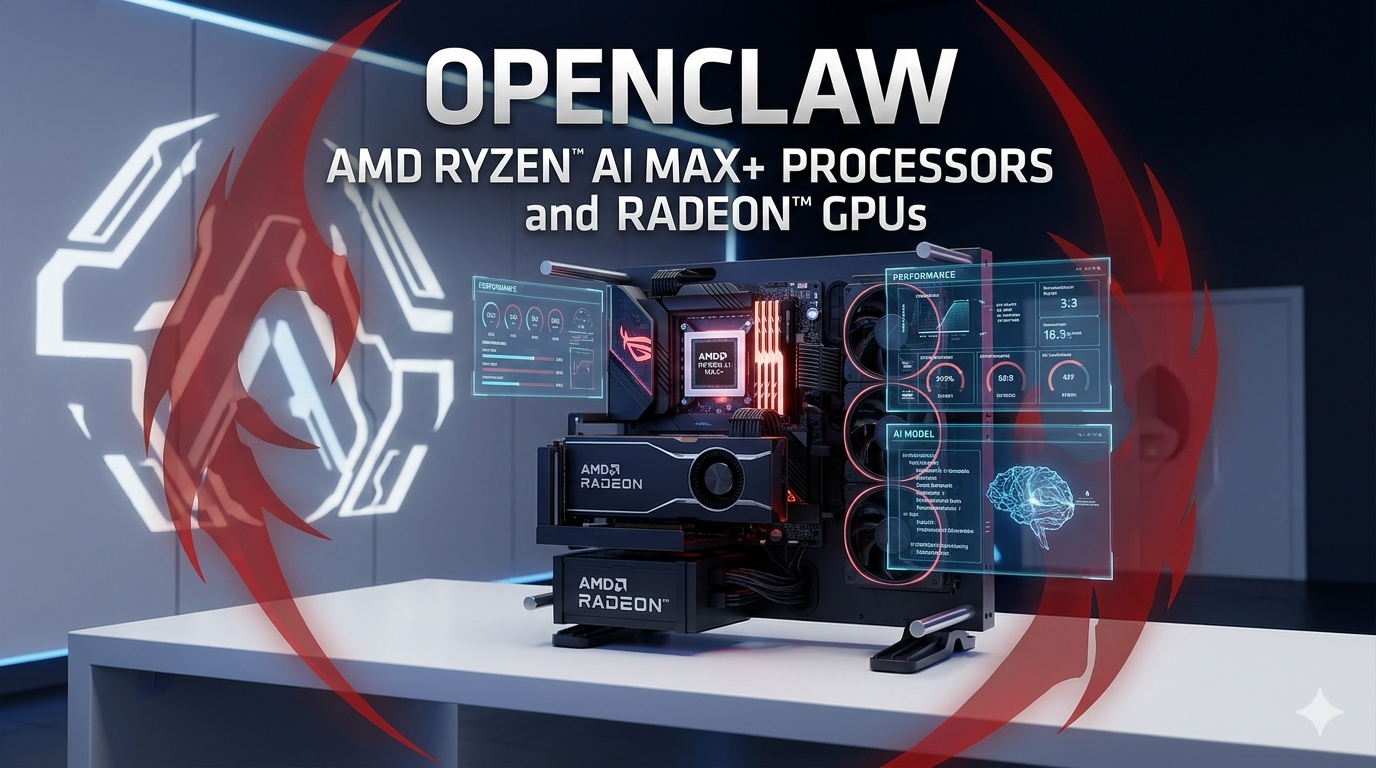
The landscape of artificial intelligence is shifting from cloud-based APIs to local hardware, ushering in the era of the “Agent Computer”—a system where the primary user is an AI agent rather than a human. This transition is being driven by powerful local hardware, such as the AMD Ryzen™ AI Max+ platform, which allows high-performance Large Language Models (LLMs) like Qwen 3.5 122B to run directly on personal systems.
A key development in this space is the AMD “best known configuration” (BKC) for OpenClaw via WSL2. This setup allows Windows users to run local AI agents and LLM workloads efficiently without sacrificing the familiarity of their primary operating system. By utilizing LM Studio and llama.cpp, the configuration supports fully local LLM provisioning and persistent memory through local embeddings. It also integrates browser control within the WSL2 environment, enabling automated agent workflows that can be configured in less than an hour.
Performance benchmarks for the Ryzen™ AI Max+ demonstrate that consumer-grade hardware with 128GB of unified memory can now handle “cloud-quality” workloads. For instance, the system can process approximately 45 tokens per second using the Qwen 3.5 35B model and manage a massive context window of 260,000 tokens. Perhaps most notably, the hardware supports “agent swarms,” running up to six agents concurrently, which allows for sophisticated local AI experimentation and multi-agent collaboration with high responsiveness.