
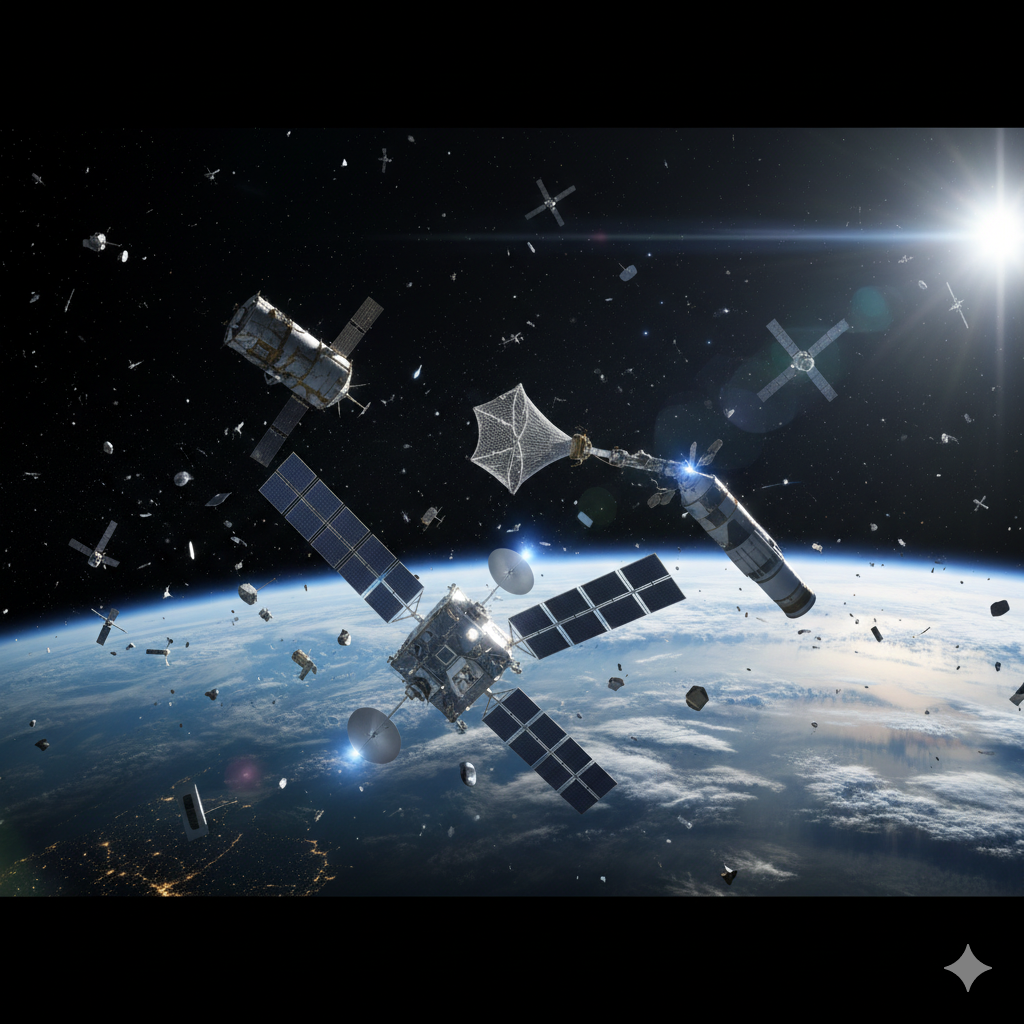
The new space age is no longer a future concept – it is a high traffic reality. As we kick off 2026, the data indicates we are approaching a critical inflection point in how we manage our orbital environment.
The number of satellites in orbit has grown exponentially over the years. The number of active payloads has essentially tripled in just a few years. Constellations such as Starlink and Amazon Kuiper account for a large proportion of satellites.
While active satellites are maneuverable, the “dead” population is not. The Kessler Syndrome, a theoretical chain reaction of collisions is moving from science fiction toward a statistical probability. There are currently 32,410 objects tracked in orbit, including rocket stages and dead satellites. This creates an invisible threat where up to 1 million debris fragments from 1cm to 10cm are in orbit. At orbital speeds of 7 km/s, a 1cm fragment carries the energy of a hand grenade.
In 2026, 80% of all satellites are commercially owned. With the United States maintaining a massive lead, though China is accelerating its “Qianfan” (Spacesail) constellation deployment.
The most interesting tech news this year isn’t about launching—it’s about retrieving. The Space Debris Removal & Monitoring Market is projected to reach $1.4 billion this year, growing at a CAGR of 7.1%. Companies like Astroscale and ClearSpace are transitioning from “demos” to “service contracts” with major space agencies. The integration of AI for real-time collision avoidance is now a standard requirement for new mega-constellations like Amazon Kuiper.
As we populate space with our technology, the debate would be whether we can manage our waste sustainably and effectively. Satellites contain numerous materials from metals to plastics, satellite end of life cycles have to ensure that materials are retrieved and recycled. Space is the ultimate “Global Commons.” If we don’t treat orbital paths as a finite resource, we risk locking ourselves out of the very heavens we are trying to explore.
Source: Google Gemini